The clocks go back on Sunday 25 October, and suddenly it is dark by teatime. For anyone who likes looking up, that is good news: long nights, and this autumn a particularly good line-up. Here is what to look for from Britain between now and the end of the year. Times are for London; they shift by a few minutes elsewhere in the country.
October: Saturn's best
Saturn reaches opposition on 5 October, when Earth passes between it and the Sun. It rises at sunset, is up all night, and around one in the morning stands about 40° above the southern horizon. At magnitude 0.6 it looks like a steady, creamy-yellow star. Any small telescope at 30× or more will show the rings, and the moon Titan as a star-like point beside it.
Mercury reaches its greatest distance from the Sun in the evening sky on 12 October, but don't bother. On autumn evenings the planets' path meets the horizon at a shallow angle, and from Britain Mercury barely clears the horizon after sunset. Wait for November instead.
The Orionid meteor shower, made of dust from Halley's Comet, peaks around 21 October. The Moon, a few days short of full, sets in the early hours, leaving the sky dark before dawn, which is the best time for meteors anyway. Expect up to 20 an hour from a dark site. There is more about the comet behind them in Halley's Comet: the prediction that came true.
November: a planetary pairing
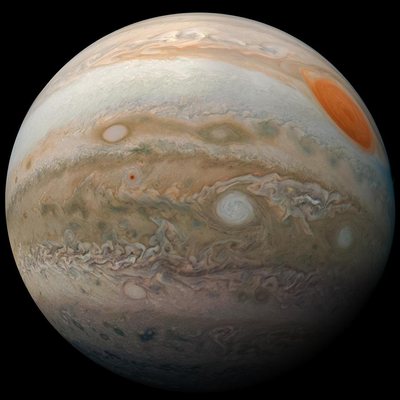
This is the highlight of the season. Early in the month, look high in the south-south-east before dawn and you will see brilliant Jupiter and, below it, the fainter orange dot of Mars, closing in day by day. On the morning of 16 November they are just 1.2° apart, close enough to cover with a fingertip at arm's length, and more than 50° up at half past five. Binoculars will show Jupiter's four big moons in a line beside it.
The same mornings bring the season's best chance to catch Mercury. Around its greatest elongation on 21 November it stands about 10° above the south-east horizon three quarters of an hour before sunrise. Find a spot with a clear, low view in that direction; binoculars help, but put them away before the Sun comes up.
The Leonids peak on 17 November. The first quarter Moon sets around midnight, so the pre-dawn hours are dark, though this is usually a modest shower of perhaps 15 an hour.
Uranus reaches opposition on 26 November. At magnitude 5.6 it is just visible to the naked eye from a truly dark site, and easy in binoculars as a faint star with a greenish tint. Unfortunately the Moon is full on 24 November, so give it a week and hunt for it in early December instead. It was, of course, discovered from a garden in Bath.
December: the best meteor shower of the year
The Geminids are the richest shower of the year, with up to 150 meteors an hour at their peak on the night of 13 to 14 December. This year the timing is excellent: the Moon is a thin crescent that sets early in the evening, leaving the whole night dark. Unlike most showers, the Geminids are active from mid-evening, so you do not need to stay up until dawn. Wrap up very warmly, lie back on a reclining chair, and look up rather than at the radiant.
Meanwhile Venus is climbing into the morning sky, a dazzling point low in the south-east before sunrise. It keeps pulling away from the Sun until its greatest elongation on 4 January 2027.
The winter solstice falls on 21 December, the longest night of the year. From the north of Scotland, that is more than seventeen hours without the Sun.
Dark nights for a trip
If you are planning a visit to a dark sky place, aim for the days around new Moon: 10 October, 9 November and 9 December. The full Moons fall on 26 October, 24 November and, fittingly, Christmas Eve.
Looking ahead
Early 2027 brings two more oppositions: Jupiter on 11 February and Mars on 20 February. Keep an eye on the events calendar, which works everything out afresh each time you visit, and use Tonight to see exactly where each planet is from your own town.
← All posts · Back to the orrery