Draw the orbits of the planets from the side and you get something surprisingly neat: eight paths that lie almost on top of one another. Mercury's orbit is tilted by about 7° to Earth's; every other planet is within about 3.5°. The Solar System is, for practical purposes, flat. Why?
It starts with a spinning cloud
About 4.6 billion years ago, the material that became the Sun and planets was a loose cloud of gas and dust, turning very slowly. As gravity pulled it inwards, it had to spin faster, just as a figure skater speeds up by pulling in their arms. This is the conservation of angular momentum, and it is the key to the whole story.
Along the axis of rotation, nothing resisted the collapse, so the cloud fell in. But around the equator, the faster spin pushed back against gravity. The cloud could collapse easily from top and bottom, but not from the sides.
Collisions do the rest
Inside the cloud, particles were moving in every direction. Whenever two collided, their up-and-down motions tended to cancel out, while their shared motion around the centre survived. Over time, everything settled into a thin, spinning disc with the young Sun at the middle. The planets formed within that disc, so they inherited its flatness and its direction of spin. That is why every planet also orbits the Sun in the same direction.
We can now see this happening around other stars. In 2014 the ALMA telescope array in Chile photographed the young star HL Tauri, surrounded by a flat disc of dust already scored with gaps where planets appear to be forming.
Flat things everywhere
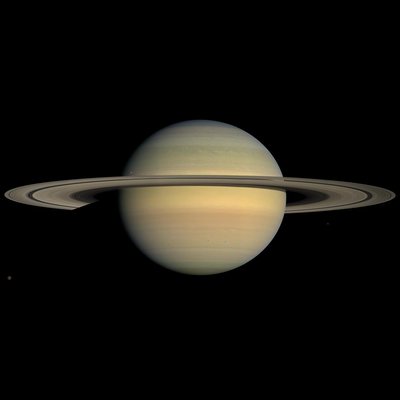
The same physics explains Saturn's rings, which span 280,000 km but are typically only tens of metres thick, and the flat discs of spiral galaxies like our own. Whenever a large spinning system of particles has time to settle, it ends up as a disc.
What does not fit
Not everything obeys. Pluto's orbit is tilted by 17°, a sign that it was nudged about by Neptune long ago. Comets from the distant Oort cloud arrive from every direction, because the gravity of the giant planets flung them out into a vast sphere early in the Solar System's history. And the planets' own spin axes can be tipped by collisions: Earth leans by 23.4°, giving us seasons, and Uranus has been knocked right over onto its side.
See it for yourself
Because the planets share one plane, they all travel along the same narrow band across our sky, the ecliptic, close to the path the Sun and Moon follow. When several planets are visible at once, they appear strung out in a line. That is the reason behind the "planetary alignments" that fill the news, which we explain in what a planetary alignment really means. Watch the flat Solar System in motion on the orrery, or see how it would stretch across the country on the Solar System on Britain.
← All posts · Back to the orrery